A Journey to the Beating Heart of the Future of Textiles in Frankfurt
There is one moment at massive trade fairs, an elusive moment that usually happens early in the morning, before the crowds flood the corridors. It is the moment when you can hear the silence before the storm, the subtle electrical hum of thousands of machines waiting to come to life, and that unique smell – a mixture of new fibers, polished steel, and industrial progress. Last week (April 21-24), at the massive Messe Frankfurt exhibition center, that moment was charged with the electricity of history changing before our very eyes.
The dual exhibition Techtextil and Texprocess is much more than a commercial event. It is where humanity re-examines one of its most basic and ancient needs: how we dress, how we manufacture, and how we clothe our world without destroying it. This article is a journey behind the scenes of an event that is essentially a massive, sober love letter to the global textile industry.
https://www.instagram.com/reel/DXY_QJOjO-p/
The Dance of Material and Machine: Why Two Exhibitions Anyway?
To understand the magic of Frankfurt, one must understand the evolution. The Techtextil exhibition was born in 1986 out of the realization that textiles were no longer just cotton shirts, but sophisticated materials that travel into space or build bridges. The exhibition became the Mecca of the "what" – the materials themselves. But as the years passed, a deep need arose to also understand the "how." How do we process these materials in an age of labor shortages and climate crisis?
Thus, in 2011, the sister exhibition, Texprocess, was born. Since then, the separation between them is purely physical, but the synergy is the lifeblood of the event: on one side you touch a smart fiber, and on the other stands the robotic system meant to process it. Olaf Schmidt, Vice President for Textiles at Messe Frankfurt, and Dr. Harald Weber from the German Textile Machinery Association (VDMA), conduct this orchestra together.
The 2026 numbers tell the story of an industry at a boiling point: over 1,700 exhibitors from 49 countries, and more than 35,000 professionals, researchers, and decision-makers from 90 countries flooded the halls.
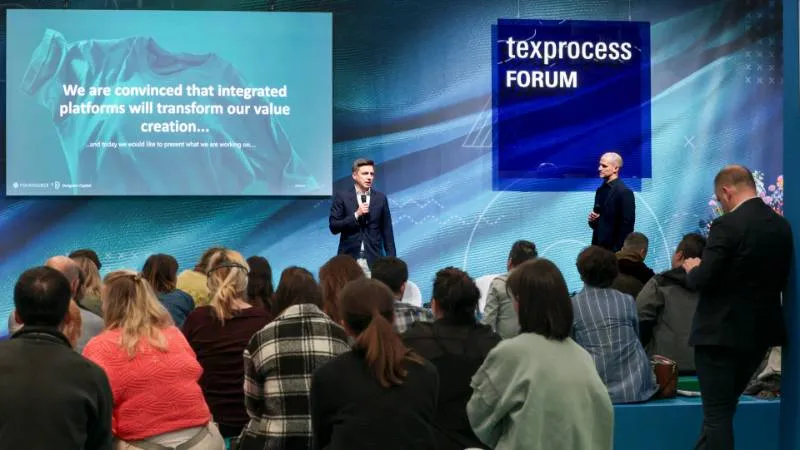
European Regulation
What was once "just" a headache for designers and engineers has now become an existential threat to brands. Europe in 2026 is no longer "asking nicely." It is legislating. As part of the European Green Deal and the Ecodesign for Sustainable Products Regulation (ESPR), the European Union is setting draconian sustainability standards. Moreover, "Extended Producer Responsibility" (EPR) laws are now imposing taxes and heavy fines on brands for the textile waste they generate, both on the factory floor and at the end of the product's life.
The atmosphere in Frankfurt was clear: those who do not recalculate their route simply won't be able to sell in Europe. The industry understands that it must change, and fast.
5 Quiet Revolutions Changing the World
Under this regulatory and moral pressure, this year's exhibition mapped out the industry's practical roadmap through 5 key trends that aim to minimize damage and optimize what exists:
1. Digital Product Passport: An End to Anonymity
The most direct response to EU demands. At Techtextil, cutting-edge technologies were presented, including optical markers embedded within the fiber and blockchain software. The new European law requires transparency, and now every garment can carry a tamper-proof digital "ID card" showing exactly where the raw material came from, how much water production consumed, and how it can be recycled.
2. Digital Twins: Patterns Born in the Cloud
To save the massive waste of producing prototypes and samples, the garment is now born in the virtual world. 3D simulation systems displayed at the exhibition mimic fabric physics at the pixel level. High-fashion designers or those creating complex collections can see exactly how the fabric will "fall" on the body in motion, and send more precise data to the cutting room to reduce errors and scraps.
3. Micro-Factories and the 3D Knitting Revolution
The old model of blindly producing millions of items in the Far East and storing them in giant warehouses only for them to be sold at discounts or destroyed – is collapsing. We saw in Frankfurt how micro-factories are becoming a reality, largely due to the massive development in knitting, and especially 3D knitting. Modern knitting machines allow for digital data entry and the creation of garments or complex panels with stunning precision, from raw yarn to the finished knit. This is a model that enables on-demand production – compact and smart production lines that can be located at the back of a local logistics center and even close to points of sale within the city. The customer orders, and the machine knits the item for them. This way, chains can react to trends in the blink of an eye, produce small batches, and eliminate the inventory surplus problem that is choking the planet.
4. Smart Textiles and Wearable Electronics
The boundary between clothing and electronic devices continues to disappear. We saw conductive threads integrated into fabrics, fabrics that change their thermal insulation level according to body temperature, and technical textiles for the automotive industry that serve as sensor networks for real-time impact detection.
5. Bio-materials and Alternatives to Petroleum-Based Products
To deal with the environmental damage of the polyester industry, leading companies showed the future of fibers – materials grown from algae, mushroom mycelium, and agricultural waste. New processing technologies allow these materials to reach high levels of strength and flexibility, while maintaining natural biodegradability.
Towards the Horizon
When the lights turned off on Friday evening at the Frankfurt fairgrounds, and hundreds of trucks began folding up the giant displays, one thing was clear to everyone who stepped out into the European spring air: the textile industry is opening its eyes. Faced with a climate crisis and economic and regulatory challenges, it is not giving up. On the contrary – it is harnessing the brightest minds and the most advanced algorithms to recalculate its route.
The halls in Frankfurt proved beyond a doubt that technology is not the enemy of tradition, but its successor. Through touchscreens, laser sensors, robot arms, and lines of code, pulses that same ancient desire – to create a garment that will clothe us, that will protect us, and that will tell our story. Only this time, we are learning to do it with deep respect for the environment and the material. The textile industry is marching toward an era where innovation restores the soul to the raw material, and we, here at StyleMe Pro, will continue to be there to feel and document every beat of this living, beating heart.