The story of Karl Mayer – the empire that taught metal how to knit dreams
What is a thread? For most of us, it is just a thin line of cotton or polyester. But if you ask the engineers in Obertshausen, Germany, they will tell you that a thread is a language. A language you need to know how to speak, how to stretch with the precision of a hair, and how to turn into a texture that protects the human body, provides it with beauty, and allows it to move.
Ahead of the opening of the Global Innovation Center (April 2026), we embarked on a journey along the timeline of the Karl Mayer Group - the company that has become the beating heart of the global textile industry. This is a story about rigorous German precision, years of dark shadows, and a technological resurgence that changed the way humanity dresses.

The early years: The smell of oil and the sound of metal
It all began in 1937. Imagine a small mechanical workshop in the German town of Obertshausen. The air there was saturated with the pungent smell of heavy machine oil, and the dominant sound was the thumping of a hammer on an anvil. In those days, Germany was turning into a giant engineering laboratory. The young workshop was not concerned with fashion at that time; it was concerned with metal.
These were complex years. The factory, as an integral part of the German economy of the 1940s, was converted to produce precise armament components for the war effort. This is a chapter of shadows in the company's history – years in which engineering knowledge served destructive goals, and the factory floor witnessed the presence of women who were brought in as forced labor from the East to operate the machines. At the end of the war, the factory stood as a pile of rubble, a silent witness to the destruction that the war brought upon all of Europe.
The moment the machine became a piano
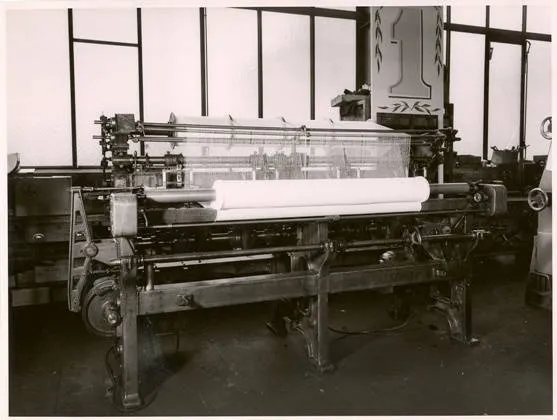
But in 1948, something happened that changed the fate of the industry. From the ruins, it was decided to build everything anew, but with an entirely different purpose: creation instead of destruction. That same year, the first Tricot machine was born.
When the first gears began to turn and the needles began to dance at a rapid pace, it wasn't just industrial noise. To those who understand textiles, it sounded like a piano that someone had learned to play complex melodies of fabric on. This machine knew how to knit threads with the speed of a hurricane and the precision of a watchmaker, and it became a symbol of rehabilitation - the ability to take cold iron and produce from it soft fabrics that provide comfort and beauty to a humanity that sought to heal.
The global chess game: The silent conquest of the market
Karl Mayer did not grow alone. It operated within a boiling arena of giant competitors. In neighboring Italy, companies like Santoni and Itema brought the "soul" – spectacular design and smart software. In Japan, giants like Shima Seiki introduced groundbreaking electronic innovation.
To become #1 in the world, the group adopted a "joining forces" strategy. It understood that in the new world, you must offer everything:
In 2014 it acquired the German company LIBA: A union of two German engineering minds that became a single entity dominating the field of warp knitting.
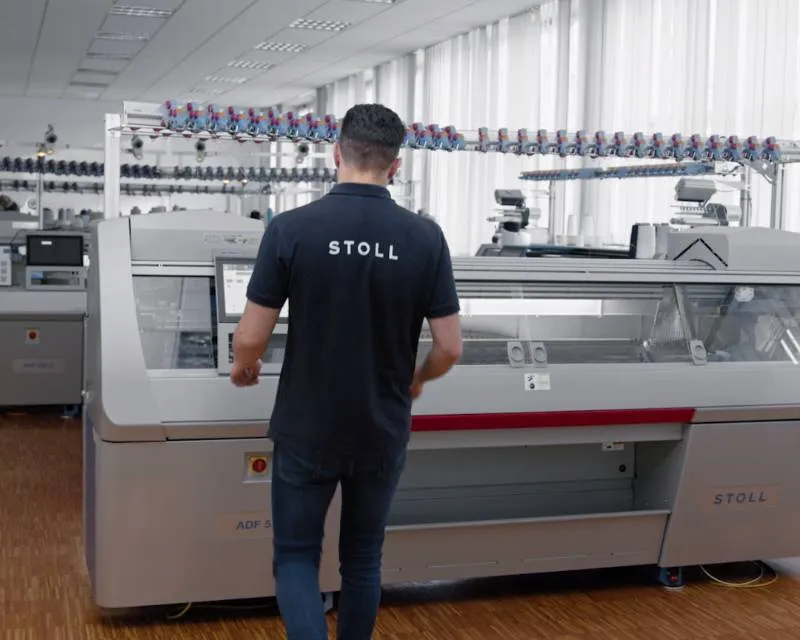
In 2020, the historic acquisition of STOLL took place: This was the moment German iron met the art of flat knitting. This acquisition allowed the group to control all types of existing fabrics – from luxury sweaters to technological fabrics for airplanes.
| Main Competitor | Country | Area of Expertise |
| Shima Seiki | Japan | Computerized flat knitting |
| Picanol | Belgium | High-speed weaving looms |
| Itema | Italy | Design weaving looms |
| Santoni | Italy | Seamless knitting |
2026 - The new home of tomorrow
And here we have arrived at the present. This week, the Karl Mayer Innovation Center was opened in Obertshausen. A massive structure of 5,000 square meters that is a statement of intent for the future.
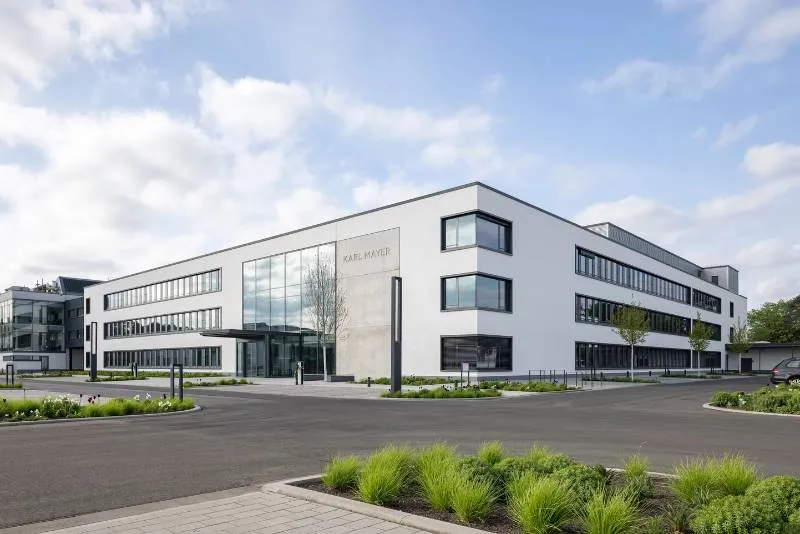
Why is the company investing millions in this structure? Because the world is undergoing a revolution. We no longer just want clothes; we want sustainability. This center is dedicated to the Zero Waste vision. The new machines are equipped with artificial intelligence (AI) that knows how to calculate every gram of thread. The goal is to produce the fabric exactly to measure, so that no piece of material will fall to the floor and be thrown in the trash.
Thanks to their digitization arm, KM.ON, the machines are no longer just "pieces of iron." They are smart systems that are connected to the cloud, allowing designers from anywhere in the world to send production commands in real-time and turn a digital vision into a physical product within minutes.
The thread that binds past and future
The Karl Mayer Group of 2026 is a testament to the human and industrial trajectory. It started in a place of darkness and brute force, and underwent a long process of refinement until it became a pioneer of clean and smart technology.
The new center is not just a place for machines, it is a place of communication between generations. It reminds us that the best engineering is that which serves the world and does not try to conquer it. This is a story about precision that became a tool for creation, and about a company that proved that even from the heaviest iron, it is possible to produce a delicacy that binds us all together.