How Helen Blanchard Broke Singer's Monopoly
In previous centuries, seeing a successful female entrepreneur in the world of engineering and machinery was rarer than a solar eclipse. The industry was dominated by huge corporations, men with deep pockets and aggressive monopolies. But 150 years ago, one woman found herself with her back against the wall, and decided not only to fight the monopoly – but to change the way the world has been sewing clothes to this very day.

Helen Augusta Blanchard was born into a wealthy family of shipowners in Maine, USA. Life was comfortable, until a severe financial crisis in 1866 (following the American Civil War) wiped out the entire family inheritance, leaving them destitute. Helen, unwilling to accept a life of poverty, had to reinvent herself. She decided to enter the textile market – a market that was at the time locked away in a steel vault by a sewing machine cartel led by the Singer company.
Singer and its partners were the monster of the era. They created a "technological and legal lock" that crushed anyone who tried to build a sewing machine and compete with them. Helen quickly understood something that today's startup founders learn the hard way: You have no chance of defeating a strong monopoly head-on on its own turf.
So instead of looking at Singer's ironworks, she started looking at the clothes that these ironworks produced. There, she discovered the deadly weak point that caused the entire industry to bleed money.
Market Failure: The Straight Stitch That Broke the Industry
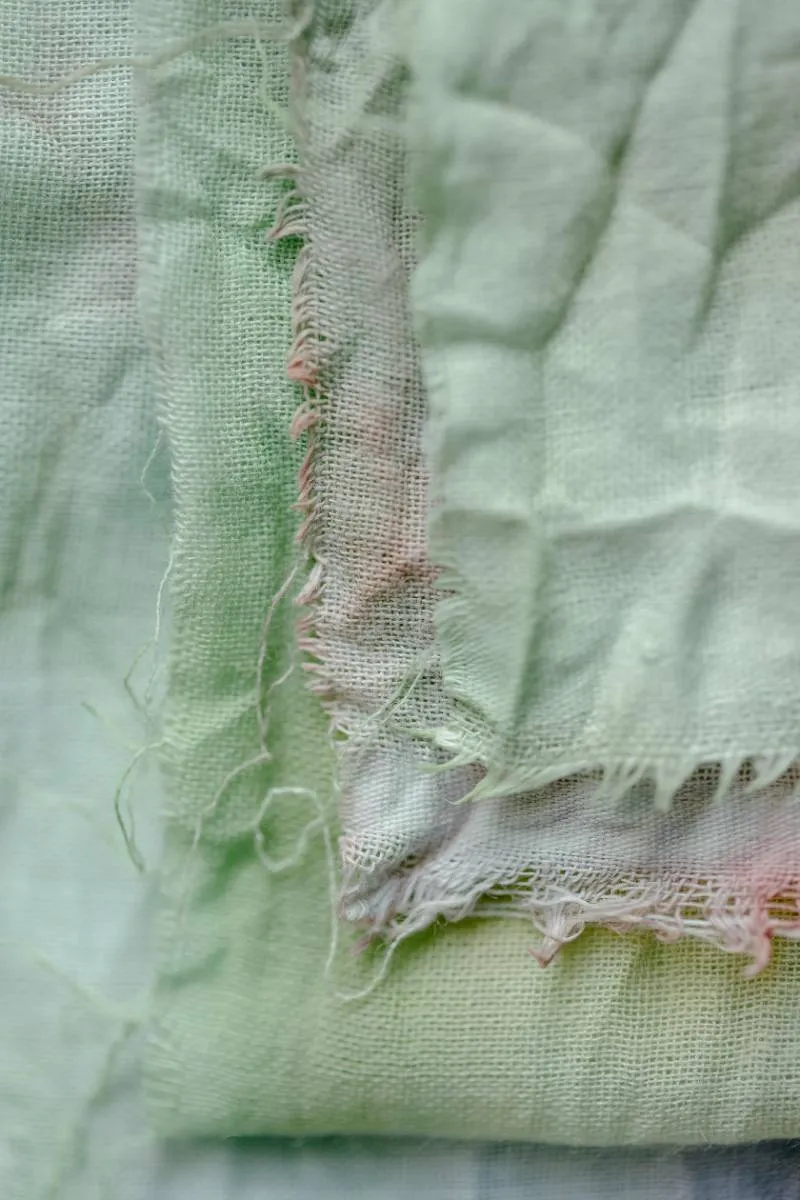
Blanchard identified that Singer's expensive and fast machines could only do one thing: sew in straight lines (Straight Stitch). The enormous problem was that the edges of the garments remained exposed. The moment the customer wore the garment or washed it, the fabric edges began to fray, and the garment simply fell apart. Garment manufacturers lost a fortune on defective merchandise and angry customers, and Singer – for all its size – provided no solution.
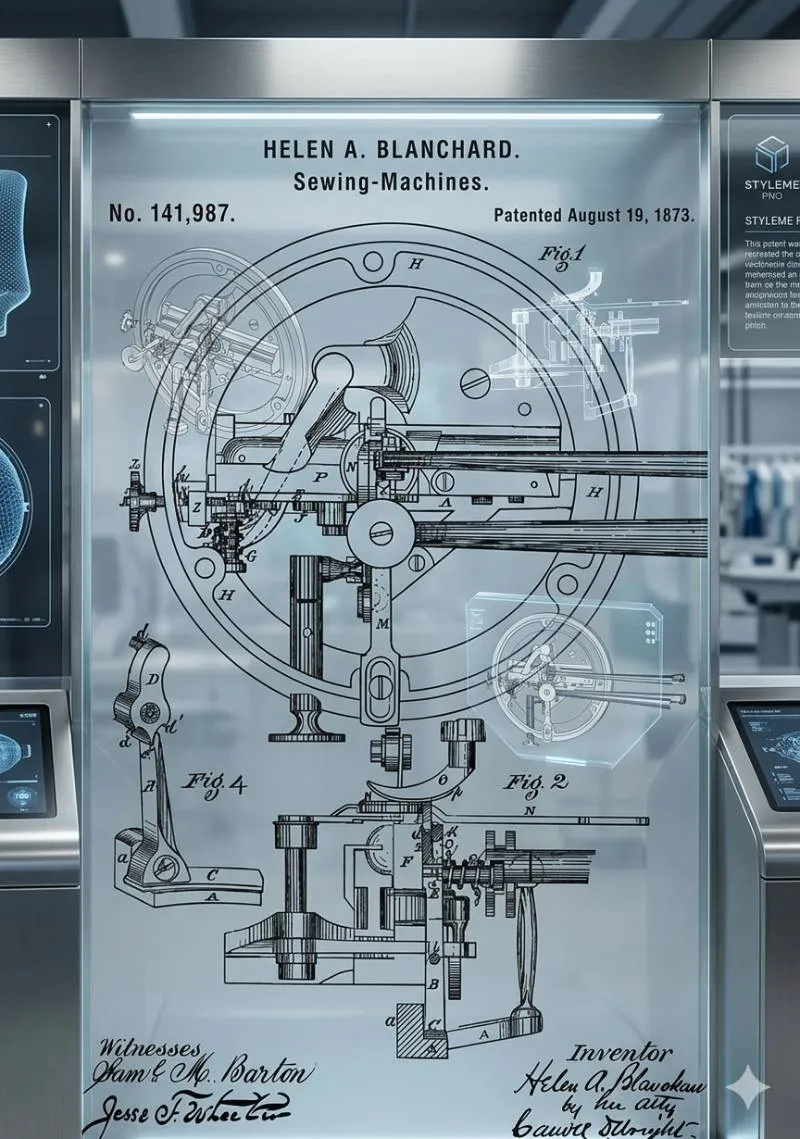
Instead of trying to invent another straight stitch machine and being crushed, Blanchard executed a ruthless business and engineering pivot. In 1873, she engineered and patented No. 141,987: The world's first sewing machine capable of performing a zigzag stitch and overseaming.
The Engineering Genius Behind the Zigzag
Technically speaking, Blanchard's move was an engineering marvel. Unlike the straight stitch, where fabric feeding is linear (only forward), the zigzag stitch requires perfect synchronization between three axes simultaneously:
- Pulling the fabric forward.
- Vertical movement (up-down) of the needle.
- Lateral (right-left) displacement of the needle mechanism.
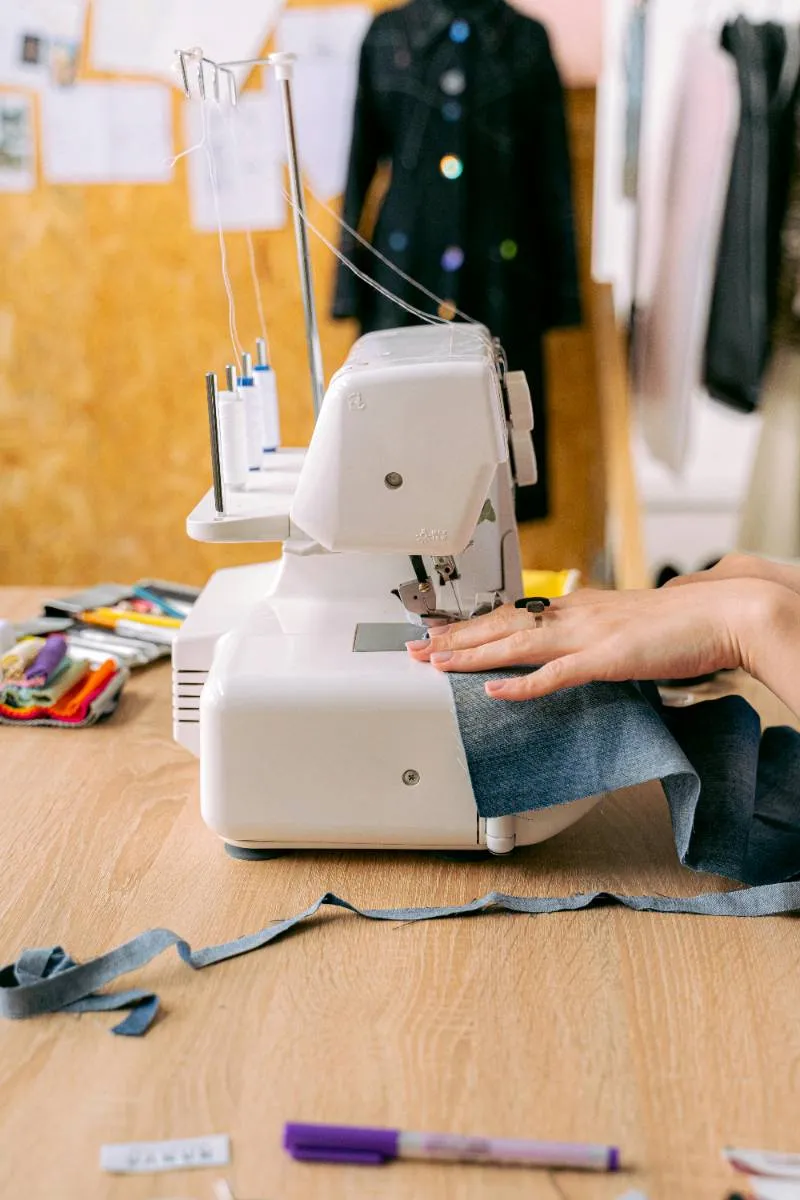
Helen succeeded in designing a complex mechanical timing mechanism that changes the needle's angle while in motion at high speed, combining the upper thread with the lower bobbin without breaking the needle or missing the loop. Her patent allowed the fabric edges to be covered and reinforced simultaneously. This is the mechanical basis for modern, durable textile production.
Overseaming to Overlock: The Evolution That Fathered Modern Fashion
Helen Blanchard's invention was a watershed moment in textile engineering. Before her patent, all machines sewed "within" the fabric's borders. Blanchard, in a stroke of genius, went outside the box – literally – causing the needle to go beyond the fabric's raw edge and return, so the thread wraps and locks the edges (an action that came to be known as Overseaming).
This kinetic breakthrough, which shattered the straight seam paradigm, underwent a fascinating evolution in the following decades. Other engineers (like the Merrow family in 1881) took Blanchard's invention as a base and refined it into an industrial marvel. They added two critical components to the system that gave birth to the modern "Overlock" machine:
- Loopers System: Instead of a simple lower bobbin, tiny metal arms were integrated, enabling the feed of 3, 4, or even 5 threads simultaneously. The loopers interlock with the upper needle to create a dense and elastic thread network around the edge.
- Knives System: Precise knives were added to the mechanism to trim and align the fabric's edge just a millimeter before the needle wraps around it, ensuring a perfect and clean finish without stray fibers.
Without Blanchard’s first and critical step to create the embracing side seam, modern fashion simply wouldn’t exist. Every basic t-shirt we wear, stretchy activewear, swimwear, and underwear – all require a special elastic seam that doesn’t tear when the fabric stretches on the body, and a sealed edge that survives dozens of washes without fraying. The entire global fashion industry, with all its speed and vast scale, rides entirely on the back of that one brilliant mechanism designed by one woman 150 years ago to save her future.
The “Blue Ocean” Strategy of 1881
Once the factories realized there was a machine that could save their garments from unraveling, something amazing happened: they understood that while Singer might be producing the body of the garment, Helen Blanchard held the bottleneck of finishing.
Her meteoric rise is a masterclass in sophisticated scientific marketing based on a "fill the gap" strategy rather than head-to-head competition. Her branding wasn't "a cheaper machine than Singer," but "the only machine that keeps your garment alive." This caused factory managers to abandon brand loyalty for the only solution that prevented them from catastrophic losses on defective merchandise.
The economic analysis here is nothing short of amazing: Blanchard didn't need to hold 50% of the global market to be incredibly wealthy. In 1881, she founded the Blanchard Overseaming Company in Philadelphia. She controlled 100% of the niche market for industrial finishing. While Singer fought for small profit margins on mass sales of home sewing machines, Helen sold "specialty machines" at premium prices to the largest factories in America.
The Bottom Line
Helen Blanchard registered no less than 28 groundbreaking patents in her lifetime. She amassed enough wealth to buy back her family's historic estate, single-handedly becoming one of the most successful inventors and businesswomen of the 19th century.
Helen Blanchard's story is a living reminder to all those involved in innovation: no matter how menacing and impenetrable the monopoly facing you may seem. A brilliant mind that manages to identify the real problem of the end customer will always find a breach in the wall – and turn it into a triumphant gateway.